
TECHNIQUES
DRAWING
Drawing is central to my art. I draw on many different levels, each with a different emphasis. My drawing practise includes sketchbooks, life studies, imaginative drawing and large-scale finished drawings, as well as the drawing that forms the essential structure of every piece of art I have ever made.
Large-scale Finished Drawings
Drawings are usually perceived as somehow inferior to paintings, but I believe this is principally because of market demands. I have always produced large-scale, highly finished drawings, and consider them to be every bit the equal to my paintings.
Some of these drawings have been based on specific ideas, but the best of them were driven into shape by an intense inner need. They begin by drawing abstract shapes in charcoal, and with great effort they evolve into complex and tightly composed narratives over a period of time.
Life Drawing
The term life drawing is traditionally associated with the figure, but for me it encompasses the whole visual arena of life. I draw from life to expand my visual vocabulary and keep my hand, eye and mind in peak artistic condition. Drawing is a bit like physical exercise in that you have to keep doing it to stay fit.
I favour charcoal on heavy paper for most of my drawing. Charcoal is an extremely direct yet absolutely flexible medium, enabling large areas of tone to be built up quickly and erased just as quickly. To charcoal I would add various compressed charcoals, charcoal pencils and hard and soft erasers to get a full tonal range and wide variety of mark. The eraser is as essential to me as a mark-making tool as the charcoal itself.
Drawing from life forces us to look with an intense gaze, and it is through this intense gaze that an artist learns new shapes, colours and compositional arrangements. This constant enrichment of visual vocabulary keeps an artist’s mind fresh.
Imaginative Drawings
Drawing from life alone would give a rather limited vision of the world, because it does not take into account the complex internal world of the human mind. Within each of us is a treasure trove of imagery that, when unlocked, can give powerful insights into the human condition.
The process of drawing from life and imagination go hand in hand, both disciplines informing and enriching the other. Drawings dredged from an inner vision are occasionally beyond immediate comprehension, yet with time their meanings are revealed. This affirms my trust in the intrinsic power of instinct and emotion as creative forces, over and above intellectual rationalisation.
My search for meaning in the work usually comes after I have created it, not when I am creating it. The work is easier to understand when seen in the context of its time, thus my working method is to have lots of things on the go simultaneously, all at different stages of completion. Occasionally I have to wait years to understand enough about a picture to continue working on it.
PAINTING
My approach to painting is to always use the finest materials possible. To that end I always prefer to make my own paint, because this gives the vibrant pure colour I desire.
My oil paint consists of pure pigment ground in cold-pressed linseed oil, with no other additives whatsoever. This ritual of grinding my own pigments gives me a close relationship to each one, as well as a deeper understanding of the personality of each pigment, which casually squeezing shop-bought paints from the tube does not give.
Some pigments like vermilion veer towards translucency, while others like cadmium red are opaque. Some colours like cobalt turquoise give off internal light, while others seem to absorb light. Some colours are granular and some are so fine it can be difficult to get them to mix with water. Such is the excitement of making your own paint.
For watercolours I use pigment with gum Arabic, though I have recently begun experimenting with Lascaux aquacryl as a binder, with pleasing results. I also use Lascaux gouache and aquacryl, and favour ongoing experimentation with materials and technique.
I once had a happy and productive affair with egg tempera. This is the Italian Renaissance technique of mixing pigment with egg yolk, which is then painted on a smooth semi-absorbent gesso ground. The intensity of colour with this technique is magical, but unfortunately the cold, damp Shetland climate and egg tempera do not like each other.
I use the best quality papers and canvases that I can afford, but tend to use cheap decorators brushes for most things except the finest detail. Expensive sable brushes are soon ruined after a few days painting on a Shetland beach.
PRINTMAKING
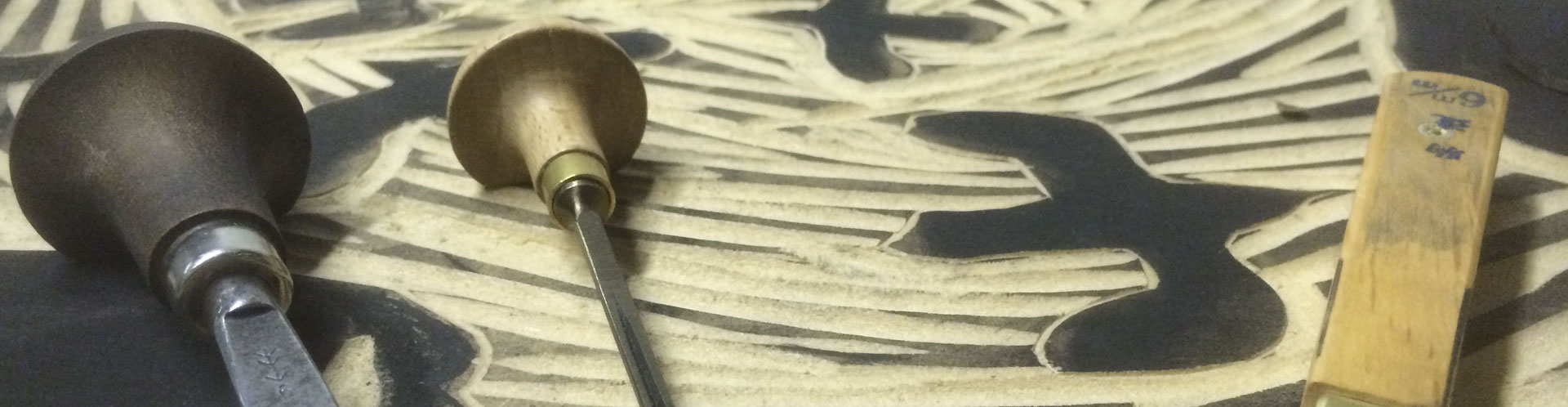
Woodcuts
I seem to have a natural affinity with woodcuts that is probably born out of my love of drawing, mark-making and strong design.
The demands of cutting a block require imaginative mark-making solutions to specific spatial problems. Cutting directly into a woodblock requires clarity of vision because a woodblock is unforgiving of mistakes.
I work on large sheets of MDF, and begin with charcoal drawn directly on the block. This stage is the most difficult, and may take days, months or years. I do not even consider cutting until every area of the block is accounted for. This allows me to focus entirely on the cutting, because all the big pictorial decisions have already been made with charcoal. Unclear ideas are cut into sharp visual focus with the medium of woodcut.
Etching
The etched line has a magic all of its own and is impossible to replicate by any other means. It is akin to alchemy when, surrounded by chemicals and other paraphernalia, the skilled etcher can turn a copper plate into visual gold. I learned to etch at the Royal Academy by watching Norman Ackroyd do magic with nitric acid and metal.
I have produced two main series of etchings to date. The Blackcountry folio was made in the etching room of the Royal Academy, and the Shetland folio was made on a beach on the west side of the island.
DIGITAL ART
The drawing and painting apps for iPad and iPhone are exciting new artistic media with great creative potential that have opened a new era in digital painting. I have been working with this new media for about three years and it is not an understatement to say that it has revolutionised my creative process.
Initially I saw this as not much more than a portable digital sketchbook in which ideas can be captured quickly and in full colour. However, when David Hockney exhibited a room full of iPad prints, each one 6ft high, at the Royal Academy of Art in London earlier this year, the full potential of what is possible with this new media started to be unveiled.
By utilising the latest in printing technology these images glowed from the page, transferring the quality of a backlit screen onto large sheets of archival quality paper in vibrant colour.
One of the obvious advantages of drawing on an iPad or iPhone is its portability, meaning it can be taken anywhere at any time, making it ideal for open air landscape drawing, or drawing whenever there is a spare moment. Another unique advantages of drawing with an iPad is that at every stage of the creative process the image can be saved, duplicated and worked on top of. This enables great creative risks to be taken because every good stage of the image can be saved while the artists pushes the image further and further. The speed of drawing enables very complex visual ideas to be worked through and resolved in a few hours, whereas on a canvas this might take years.
There are many drawing and painting apps available, each one with different functionality. My favourite is called Brushes. This is easy to use and is hugely powerful in terms of the complex images that can be created, and in terms of the resolution at which they can be printed. The iPad enables images to be exported at a massive 122 megabytes, which in theory means they can be printed at the size of a house without any loss of resolution.
Suffice it to say this is a serious piece of kit, a cross between a pocket sketchbook and a portable art studio. I am now never without it.
You can watch two of my digital paintings taking shape in the videos below.
PHOTOGRAPHY
Photography has run parallel to my drawing and painting for over 30 years, though always in a secondary, supportive role, as an image-gathering visual sketchbook .
My first ventures into photography were in black and white film during the late 1980s, when I started to document the decline of industry in the Black Country and the effect of this on people and culture. Most of these negatives lay unprinted and forgotten about until recently I started to digitally scan some of them to see what was there. The inherent power of these images has made me completely rethink my relationship to photography .
The iPhone reawakened my interest in photography as I had a camera always in my pocket as well as the ability to edit images. I consider the iPhone an essential creative tool. However, after seeing the images on the early negatives I’ve bought some good quality cameras, and photography is an evolving area of my visual practice .
The subject matter of my photography has gone hand in hand with my drawing and painting: stark social commentary next to untainted nature and the interactions between the two.
Photography forces us to live in the moment to and to walk around with our eyes wide open, ready to capture the fleeting second. Technique and concept are secondary to composition for me and I look for pleasing interactions of shapes, my eye being constantly alert. Meaning comes later as I assess the images I’ve taken, though my driving force in photography is the same as my drawing: namely, an existential search for meaning through images.
SKETCHING
I regard the use of sketchbooks to be an essential working tool. My sketchbooks are a living, breathing part of my artistic development and have been responsible for more finished pieces and breakthroughs in my art than I care to remember. A sketchbook is one area where an artist can be truly free to record and document intimate, personal and usually private ideas. These ideas can often point the artist in significant directions.
I favour small pocket-sized books that can be taken everywhere with ease, and usually draw with a pressure-sensitive black pen that gives a wide variety of line. The contents of these books have no boundaries and are rarely seen by anyone. The imagery contained within often takes years to surface and mature into finished pieces.